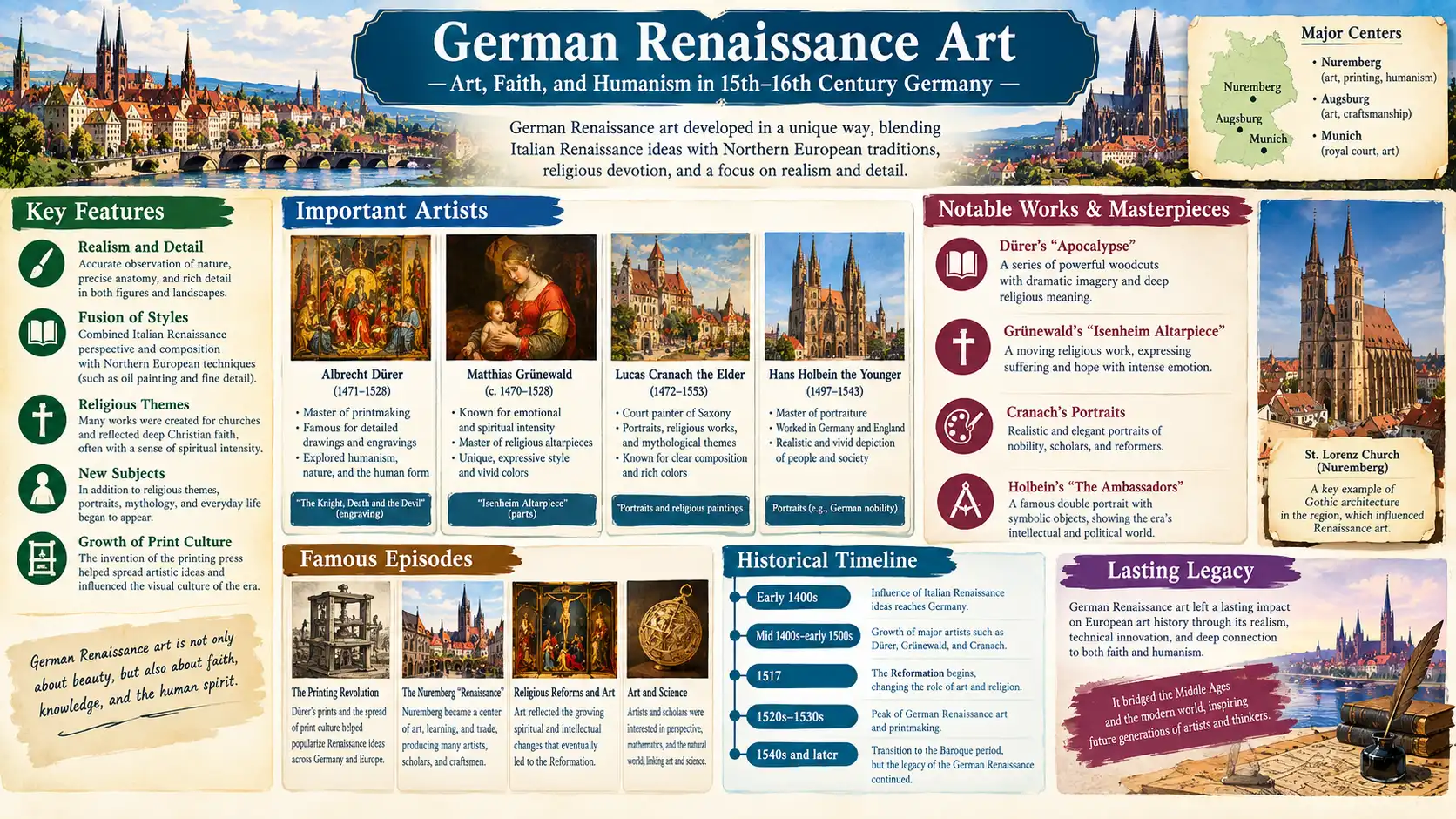
The German Renaissance saw a transformative blending of Italian Renaissance techniques with Northern European detail and spiritual depth. Spanning the 15th and 16th centuries, it was marked by groundbreaking advances in printmaking, woodcuts, and oil painting. Artists drew inspiration from humanism, nature, and the dramatic religious shifts of the Protestant Reformation. Through intricate engravings, monumental altarpieces, and penetrating portraiture, German masters established a distinct visual identity that bridged medieval traditions with scientific observation and refined realism, profoundly influencing European art history.
People
Birth Death Origin Age (Death)
1471
1472
1480
1480
1497
1515
Timeline
Category
Element
Year
German Renaissance Art
1471
Birth of Albrecht Dürer (Period: May 21, 1471, Location: Nuremberg (now Bavaria, Germany))
1472
Birth of Lucas Maler (Period: October 4, 1472, Location: Kronach (now Bavaria, Germany))
1480
Birth of Albrecht Altdorfer (Period: Circa 1480 (exact date of birth unknown), Location: Regensburg (Germany) is the most widely accepted theory, though another theory points to Altdorf near Landshut)
Birth of Matthias Grünewald (Period: Circa 1480 (exact date of birth unknown), Location: Würzburg (Germany) is the dominant theory, though the exact birth place remains unconfirmed)
Apprenticeship as a Goldsmith (Albrecht Dürer)
Artistic Education from his Father Hans Cranach (Lucas Cranach the Elder)
1486
Apprenticeship in the Workshop of Michael Wolgemut (Albrecht Dürer)
Training in the Wolgemut Workshop (Albrecht Dürer)
1490
Travels as a Journeyman (Albrecht Dürer)
Artistic Education from his Father Hans Holbein
1492
Journey to Seek Contact with Martin Schongauer (Albrecht Dürer)
1494
First Trip to Italy, to Venice (Albrecht Dürer)
Marriage (Albrecht Dürer, Agnes Frey)
1495
Establishment of the Workshop in Nuremberg (Albrecht Dürer)
1497
Birth of Hans Holbein (Period: Late 1497 to early 1498 (exact date unknown), Location: Augsburg (now Bavaria, Germany))
1498
Publication of the Woodcut Series "The Apocalypse"
1499
Swabian War
1500
Production of "Self-Portrait at Twenty-Eight"
1502
Stay in Vienna and Artistic Activities (Lucas Cranach the Elder)
Production of Early Works in Vienna (Lucas Cranach the Elder)
1504
Appointment as Court Painter to the Elector of Saxony (Lucas Cranach the Elder)
Start of Activities as Court Painter to Saxony (Lucas Cranach the Elder)
1505
Second Trip to Italy (Albrecht Dürer)
Acquisition of Regensburg Citizenship (Albrecht Altdorfer)
1506
Production of "The Martyrdom of Saint Catherine"
Production of Early Signed Works
1508
Granting of the Coat of Arms and Use of the Winged Serpent Insignia
Visit to the Court of Margaret of Austria
1510
Expansion of the Workshop in Wittenberg
1511
Travel to the Alps and Interest in Landscapes (Albrecht Altdorfer)
1512
Patronage of Maximilian I (Albrecht Dürer)
Marriage (Lucas Cranach the Elder, Barbara Brengbier)
1513
Production of the Master Engravings (Meisterstiche)
Commissions from the Court of Emperor Maximilian I (Albrecht Altdorfer)
Marriage (Albrecht Altdorfer, Anna)
1515
Relocation to Basel (Hans Holbein)
Birth of Lucas Sunder (Period: October 4, 1515, Location: Wittenberg (Germany))
1517
Execution of Murals in Lucerne
Establishment of the Relationship with Martin Luther
Participation in the Foreign Affairs Council of Regensburg (Albrecht Altdorfer)
1518
Attendance at the Diet of Augsburg (Albrecht Dürer)
1519
Death of Maximilian I and the Issue of Pension Continuation
Joining the Basel Painters' Guild and Acquisition of Citizenship (Hans Holbein)
Marriage (Hans Holbein, Elsbeth Binzenstock-Schmid)
Appointment as a Member of the Wittenberg City Council (Lucas Cranach the Elder)
Expulsion of Jews and Destruction of the Synagogue in Regensburg
1520
Growing Interest in Martin Luther (Albrecht Dürer)
Journey to the Netherlands and Confirmation of Pension by Charles V (Albrecht Dürer)
Changes in the Creative Environment Due to the Basel Reformation
Execution of Murals for Basel Town Hall and Other Buildings
Production of the "Dance of Death" Woodcuts
Acquisition of Pharmacy Operation Privileges (Lucas Cranach the Elder)
Production of Portraits of Luther
Production of Reformation Religious Paintings such as "Christ and the Adulteress"
Comments