Medical and Scientific Advances in WWI
Science and Medicine
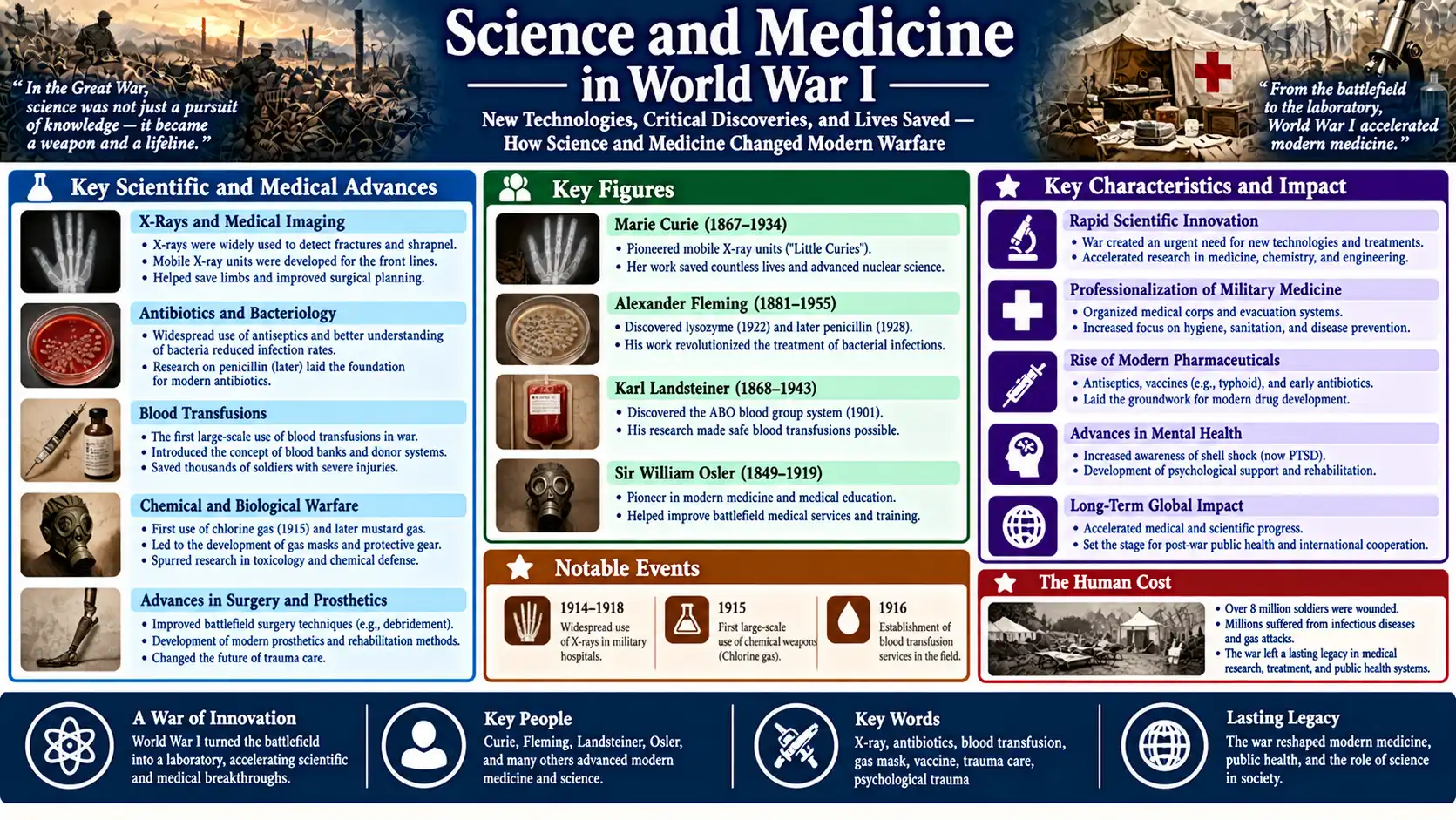
World War I accelerated medical and scientific innovation under immense wartime pressure. Military necessity spurred groundbreaking developments in trauma surgery, antiseptics, blood transfusion techniques, and mobile X-ray units, while field ambulances significantly improved triage efficiency. At the same time, industrial-scale warfare drove rapid advancements in chemical engineering, resulting in the deployment of toxic poison gases on the Western Front alongside defensive technologies like gas masks. Psychiatrists also began recognizing shell shock as a psychological trauma rather than cowardice. These wartime breakthroughs fundamentally transformed emergency care, public health protocols, and industrial chemistry worldwide.
People
Birth
Death
Origin
Age (Death)
| 1854 | |
|---|---|
| 1856 | |
| 1858 | |
| 1878 | |
| 1879 | |
| 1887 |
Timeline
| Category | |
|---|---|
| Element |
| Year | Science and Medicine |
|---|---|
| 1854 |
Birth of Paul Ehrlich (Period: March 14, 1854, Location: Strzelin (Poland))
|
| 1856 |
Birth of Sigmund Freud (Period: May 6, 1856, Location: Příbor (present-day Czech Republic))
|
| 1858 |
Birth of Max Planck (Period: April 23, 1858, Location: Kiel (present-day Germany))
|
| 1860 |
Move to Vienna (Sigmund Freud)
|
| 1870 | |
| 1872 |
Beginning of medical research
|
| 1874 |
Physics research in Munich and Berlin
|
| 1878 |
Research on staining methods for tissues and blood cells
Birth of Lise Meitner (Period: November 7, 1878, Location: Vienna (Austria))
Birth (Period: November 7, 1878, Location: Vienna (Austro-Hungarian Empire))
|
| 1879 |
Earning a doctorate (Max Planck)
Birth of Albert Einstein (Period: March 14, 1879, Location: Ulm (present-day Germany))
Birth
|
| 1881 |
Graduation from the Faculty of Medicine at the University of Vienna (Sigmund Freud)
|
| 1883 |
Marriage (Paul Ehrlich, Hedwig Pinkus)
|
| 1885 |
Appointed professor at the University of Kiel (Max Planck)
Study in Paris and research with Charcot (Sigmund Freud)
Research under Charcot
|
| 1886 |
Opening a practice in Vienna
Marriage (Sigmund Freud, Martha Bernays)
|
| 1887 |
Marriage (Max Planck, Marie Merck)
Birth of Erwin Schrödinger (Period: August 12, 1887, Location: Vienna (present-day Austria))
|
| 1888 |
Contracting tuberculosis and recuperative travel to Egypt and other regions
|
| 1889 |
Appointed professor at the University of Berlin (Max Planck)
|
| 1890 |
Blackbody radiation research and quantum hypothesis
Research on diphtheria antitoxin and development of serum therapy
Research surrounding the standardization of serum therapy
Research at the Robert Koch Institute
|
| 1896 |
Enrollment at ETH Zurich (Albert Einstein)
Use of the term psychoanalysis
|
| 1897 |
Beginning of self-analysis of the unconscious
Proposal of the side-chain theory
|
| 1900 |
Proposal of the quantum hypothesis
Research on experimental chemotherapy
|
| 1901 |
Studying physics at the University of Vienna
|
| 1902 |
Employment at the Swiss Patent Office
Formation of the Vienna Psychoanalytic Society
|
| 1903 |
Marriage (Albert Einstein, Mileva Marić)
|
| 1905 |
"Miracle Year" of 1905
Publication of Special Relativity
Publication of the light quantum hypothesis
|
| 1906 |
Enrollment at the University of Vienna (Erwin Schrödinger)
|
| 1907 |
Beginning of joint research with Otto Hahn in Berlin
|
| 1908 |
Development of the international psychoanalytic movement
Awarded the Nobel Prize in Physiology or Medicine (Paul Ehrlich)
|
| 1909 |
Lectures on psychoanalysis in the United States
Development of Salvarsan (Compound 606)
Development of Salvarsan
|
| 1910 |
Earning a doctorate (Erwin Schrödinger)
Controversy in the medical community surrounding Salvarsan
|
| 1911 |
Marriage (Max Planck, Marga von Hoesslin)
|
| 1912 |
Appointed Permanent Secretary of the Prussian Academy of Sciences (Max Planck)
Rift with Jung
Publication of "Totem and Taboo"
Research at the Kaiser Wilhelm Institute for Chemistry
Development of Neosalvarsan
|
| 1914 |
Involvement with World War I and war neurosis
Military service in World War I
Acquisition of habilitation (Erwin Schrödinger)
Appointed professor at Goethe University Frankfurt (Paul Ehrlich)
|
| 1915 |
Completion and publication of General Relativity
X-ray and radiology medical activities during World War I
Death of Paul Ehrlich
|
| 1916 |
Death of eldest son Karl in World War I
|
| 1919 |
Verification of General Relativity by the 1919 solar eclipse observation
Marriage (Albert Einstein, Elsa Löwenthal)
|
| 1920 |
Attacks by the anti-relativity movement and anti-Semitism
Awarded the Nobel Prize in Physics (Max Planck)
Publication of "Beyond the Pleasure Principle"
Research at the University of Jena
Death of daughter Sophie
Marriage (Erwin Schrödinger, Annemarie "Anny" Bertel)
|
| 1921 |
Quantum mechanics research in Zurich
Appointed professor at the University of Zurich (Erwin Schrödinger)
|
| 1922 |
Awarded the Nobel Prize in Physics (Albert Einstein)
|
| 1923 |
Onset of palate cancer
Publication of "The Ego and the Id"
|
| 1925 |
Establishment of the Schrödinger equation
|
| 1926 |
Publication of the Schrödinger equation
Appointment as Germany's first female full professor of physics (Lise Meitner)
|
| 1927 |
Appointed professor at the University of Berlin (Erwin Schrödinger)
|
| 1930 |
President of the Kaiser Wilhelm Society
Awarded the Goethe Prize (Sigmund Freud)
Publication of "Civilization and Its Discontents"
|
| 1932 |
Exchange of letters with Einstein on "Why War?"
|
| 1933 |
Establishment of the Nazi regime and departure from Germany
Emigration to the United States (Albert Einstein)
Nazi regime's control over the scientific community
Preserving the scientific community under the Nazi regime
Awarded the Nobel Prize in Physics (Erwin Schrödinger)
Opposition to the Nazi regime and departure from Germany
Activities at the University of Oxford
Anti-Semitic policies of the Nazi regime and loss of employment
Nazi book burning of works
|
| 1935 |
Proposal of the concept of quantum entanglement
|
| 1936 |
Spanish Civil War
Appointed professor at the University of Graz (Erwin Schrödinger)
|
| 1938 |
Anschluss and persecution of the Freud family
Anschluss (annexation of Austria)
Exile from Germany (Lise Meitner)
Escape and exile from Germany (Lise Meitner)
Discovery and theoretical explanation of nuclear fission
Theoretical explanation of nuclear fission
|
| 1939 |
World War II
Completion of "Moses and Monotheism"
Move to the Dublin Institute for Advanced Studies (Erwin Schrödinger)
Head of the Theoretical Physics School at the Dublin Institute for Advanced Studies
Letter of warning regarding atomic bombs to President Roosevelt
Death of Sigmund Freud
|
| 1940 |
Acquisition of US citizenship (Albert Einstein)
|
| 1942 |
Refusal to join the Manhattan Project
|
| 1943 |
Lectures on "What Is Life?"
|
| 1944 |
Destruction of home in Berlin by bombing
Publication of "What Is Life?"
Exclusion from the 1944 Nobel Prize in Chemistry (Lise Meitner)
July 20 Plot and execution of Erwin Planck
|
| 1945 |
Anti-nuclear movement after World War II
Evacuation to Göttingen
|
| 1946 |
Appointed Honorary President of the Kaiser Wilhelm Society (Max Planck)
|
| 1947 |
Death of Max Planck
|
| 1948 |
Acquisition of Irish citizenship (Erwin Schrödinger)
|
| 1949 |
Acquisition of Swedish citizenship (Lise Meitner)
|
| 1952 |
Declination of the offer to become President of Israel (Albert Einstein)
|
| 1955 |
Retirement from the Dublin Institute for Advanced Studies (Erwin Schrödinger)
Death of Albert Einstein
|
| 1956 |
Return to the University of Vienna
|
| 1960 |
Move to Cambridge (Lise Meitner)
|
| 1961 |
Death of Erwin Schrödinger
|
| 1968 |
Death of Lise Meitner
|
| Unknown |
Marriage (Lise Meitner, None, Period: No marriage history, Location: None)
|
Map
| Category | |
|---|---|
| Element |
Europe
World
Related Links
| Group | List |
|---|---|
| Western Europe | French Politics British Politics Poet and Writer Science and Medicine |
| Central Europe | German Leader Emperors of Austria-Hungary The Sarajevo Incident Science and Medicine |
Comments