Antoun Saadeh's Ideology
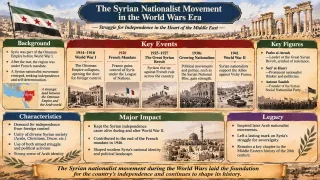
Born in Dhour Choueir in 1904, Antoun Saadeh founded the Syrian Social Nationalist Party in 1932. He advocated for a secular, unified Greater Syria, opposing both the French mandate and traditional pan-Arab nationalism.
Born in Dhour Choueir in 1904, Antoun Saadeh founded the Syrian Social Nationalist Party in 1932. He advocated for a secular, unified Greater Syria, opposing both the French mandate and traditional pan-Arab nationalism.

During the World Wars, the Palestinian national movement evolved from anti-Ottoman regionalism to active opposition against British Mandatory rule and Zionist settlement. During World War I, Arab leaders sought independence from the Ottoman Empire through alliances with the British, encapsulated in the McMahon-Hussein Correspondence. However, the post-war imposition of the Mandate and the Balfour Declaration shifted their focus toward resisting B...
Musa al-Husayni was a prominent Palestinian leader born in Jerusalem in 1853 who played a critical role in shaping early Palestinian nationalism during and after World War I. Following the fall of the Ottoman Empire and the establishment of the British Mandate, he served as Mayor of Jerusalem and later became President of the Executive Committee of the Palestine Arab Congress. Throughout the 1920s and early 1930s, he spearheaded peaceful diplomat...
Born in Motol in 1874, Chaim Weizmann was a visionary chemist and Zionist leader whose wartime efforts proved pivotal to the Zionist movement. During World War I, his development of a synthetic acetone production process vital for British munitions earned him significant influence within British political circles. Leveraging this standing, Weizmann played a central role in securing the historic Balfour Declaration of 1917, which endorsed a Jewish...
Zeev Jabotinsky, born in Odesa in 1880, was a charismatic soldier, writer, and founder of Revisionist Zionism. During World War I, he co-founded the Jewish Legion within the British Army to fight Ottoman forces, establishing a precedent for armed Jewish self-defense. Disillusioned by British policies and mainstream Zionist moderation, he authored the influential "Iron Wall" essay, asserting that a Jewish state could only be secured through milita...
Vladimir Jabotinsky, born in Odesa in 1880, was the Russian name of Zeev Jabotinsky, a prominent Zionist strategist and military organizer. During World War I, he worked alongside Joseph Trumpeldor to form the Zion Mule Corps and later the Jewish Legion within the British military, participating directly in the Gallipoli campaign. In the post-war Mandate period, he helped organize the early defense infrastructure of the Haganah in Jerusalem, lead...
Born in Jerusalem in 1881, Raghib al-Nashashibi was a key political figure in Mandatory Palestine who served as Mayor of Jerusalem from 1920 to 1934. Leading the influential Nashashibi family, he formed the National Defence Party to counter the radical anti-British line of the Husayni faction. Nashashibi championed a pragmatic, political realism, choosing engagement with British authorities to safeguard Arab interests and economic welfare. During...
Izz ad-Din al-Qassam, born in Jableh in 1882, was a Syrian Islamic scholar and anti-colonial revolutionary whose actions reshaped Palestinian resistance. After fleeing French-occupied Syria, he settled in Haifa, where he organized rural laborers and urban workers into the secret militant group known as the Black Hand. Al-Qassam preached armed jihad as the only effective defense against British Mandatory rule and expanding Zionist settlement. His ...
David Ben-Gurion, born in Płońsk in 1886, was the primary founder and first Prime Minister of Israel. After emigrating to Palestine, he emerged as the preeminent leader of Labor Zionism, heading the Histadrut labor federation and later the Executive Committee of the Jewish Agency. During World War II, Ben-Gurion adopted a dual strategy: supporting the British military against Nazi Germany while fighting British restrictions on Jewish immigration ...
Moshe Sharett, born in Kherson in 1894, was a central Israeli statesman who served as the nation's first Foreign Minister and second Prime Minister. As head of the Political Department of the Jewish Agency from 1933 to 1948, he led complex negotiations with the British Mandate administration and international bodies. During World War II, Sharett was instrumental in forming the Jewish Brigade within the British Army, enabling Jewish soldiers to co...
Amin al-Husayni, born in Jerusalem around 1895, was the Grand Mufti of Jerusalem and the principal political leader of Palestinian Arabs during the Mandate era. As head of the Supreme Muslim Council and later the Arab High Committee, he directed opposition against Zionist immigration and British rule, leading the 1936 Great Arab Revolt before being forced into exile. During World War II, al-Husayni aligned himself with the Axis powers, traveling ...
Golda Meir, born in Kyiv in 1898, was a prominent Zionist leader who later became Israel's fourth Prime Minister. Raised in the United States before moving to Mandatory Palestine, she rose through the ranks of the Labor movement and the Jewish Agency. During World War II and its immediate aftermath, Meir played a crucial role in international advocacy, touring the United States to raise tens of millions of dollars vital for Jewish defense and sta...
Abd al-Qadir al-Husayni, born in Jerusalem in 1907, was a legendary Palestinian military commander and son of Musa al-Husayni. During the 1936 Great Arab Revolt, he founded and led the Army of the Holy Jihad, conducting guerilla warfare against British forces and Jewish militias. Following the 1947 UN Partition Resolution, he returned to Palestine to reorganize his forces and command the defense of Jerusalem. Abd al-Qadir led key operations to se...

The World Wars witnessed pivotal Asian events that altered history. The 21 Demands and the Battle of Gallipoli reshaped regional dynamics, leading to the collapse of the Ottoman Empire. The conflict escalated from the Manchurian Incident to Pearl Harbor and Midway, paving the way for post-war independence.

During the World Wars, Asia was reshaped by global conflicts and regional struggles. Key campaigns like Tsingtao and Gallipoli altered Middle Eastern and East Asian dynamics. The Asian theater expanded into the Second Sino-Japanese War and the Pacific War, dismantling traditional imperial control.